

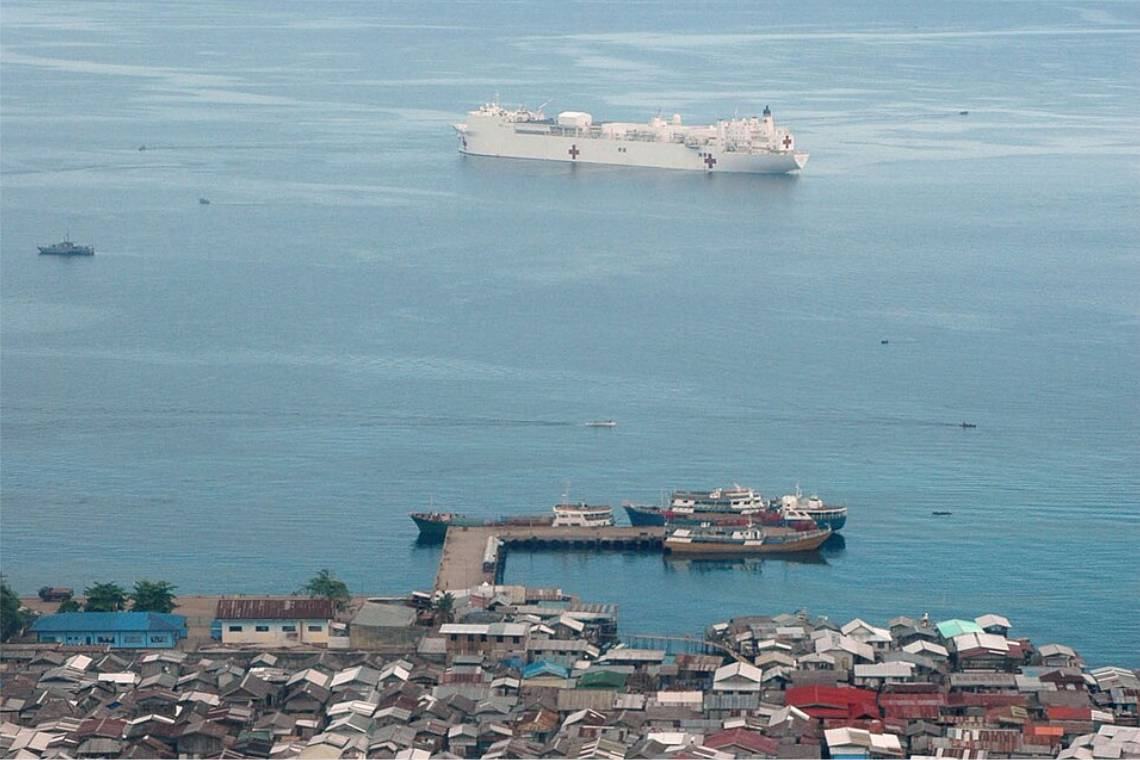
Jolo, Sulu, with US Navy hospital ship USNS Mercy. Sulu remains the poorest province in the Philippines, vulnerable to economic challenges and environmental turbulence as well as a declining albeit stubborn militant threat. Image Source: Photographer's Mate 3rd Class Timothy F. Sosa, USN.
Recent reporting indicates that Therium, a UK-based litigation funder, intends to press on with the Sulu case despite a series of decisive legal defeats. The firm is reportedly backing private intelligence and consultancy efforts aimed at keeping the dispute alive on the international stage with the objective of pushing Malaysia toward a monetary concession. That strategy has raised questions, not least because the case has already consumed an estimated $20m with no legal success to show for it.
“Despite repeated setbacks, Therium is reportedly backing private intelligence efforts aimed at keeping the dispute alive with the objective of pushing Malaysia toward a monetary concession.”
The setbacks have been substantial. On December 9, the Paris Court of Appeal dismissed the final appeal related to the Sulu arbitration, effectively ending the case in European courts. Separately, Therium pursued a failed legal action against the Spanish state after Spanish courts invalidated the appointment of the arbitrator who had initially ruled in favor of the Sulu claimants; Spanish judges had found serious flaws in the arbitration process while critics also pointed to issues surrounding the arbitrator’s conduct and independence.
Against this backdrop, the determination to continue investing heavily in the dispute appears striking. More troubling is that none of the money spent under the banner of “Sulu” has gone toward alleviating conditions in Sulu province itself.
Updated headlines for free, straight to your inbox—no noise, just facts.
We collect your email only to send you updates. No third-party access. Ever. Your privacy matters. Read our Privacy Policy for full details.
Sulu remains the poorest province in the Philippines. A report from the Pacific Disaster Center places its poverty rate at roughly 74%, with basic services in short supply. Only a little over one in three households has access to electricity. Literacy, at 83%, stands well below the national average, and life expectancy is estimated at under 60 years. These indicators underscore how far the province lags behind the rest of the country and why economic development and public investment remain urgent priorities.
There have been earnest efforts, albeit modest in scale. While Sulu was still part of the Bangsamoro Autonomous Region in Muslim Mindanao (BARMM), the regional government reported funding housing and community facilities worth about 58.7m Philippine pesos in 2024—just under $1m at current exchange rates. Similar levels of spending were directed toward education infrastructure in 2025. These initiatives often amount to a small fraction of the sums spent on litigation in faraway European courts in the name of Sulu.
“Investment projects in Sulu’s development typically amount to a small fraction of the sums spent on the Sulu claimants’ private litigation in faraway European courts.”
Therium, as a foreign private funder, has no obligation to invest in the province itself. The same cannot be said of the claimants at the heart of the case. The eight individuals advancing the claim are Filipino private citizens who assert a connection to the historical Sulu Sultanate. If they seek to invoke that heritage and claim to represent its legacy, critics argue, there is a moral expectation that their actions should benefit the people whose identity they are invoking. To date, there is no practical demonstration that litigation funding or any potential recovery would be directed toward development in Sulu.
“To date, there is no practical demonstration that litigation funding or any potential recovery would be directed toward development in Sulu.”
In recent statements, the claimants and their representatives have suggested an openness to settling the dispute with Malaysia. That language can be described as misleading. Any so-called settlement would still involve demanding compensation from Malaysia—funds that the Paris Court of Appeal has ruled should never have been awarded in the first place. With the arbitration decisively overturned, the claimants are widely viewed as lacking a legal basis to seek concessions, let alone negotiate from a position of strength.
With the arbitration now definitively closed, attention has turned to what avenues might be pursued next. Continuing to press the issue outside the framework of the failed arbitration suggests that the matter has shifted from a scheme of lawsuits to something broader, from the Sulu Arbitration to a return to the geopolitically destabilizing Sabah Dispute.
That dispute was one that Malaysia, Indonesia, and the Philippines worked to defuse diplomatically in the 1960s, recognizing the regional instability it could cause. Desperate efforts by private funders and their agents to resurrect it today risk reopening old tensions for the sake of financial leverage. All the while, the people of Sulu continue to face entrenched poverty, limited infrastructure, and scarce opportunities—conditions untouched by the millions spent pursuing a case that bears their name but offers them no tangible benefit.
REFERENCES
Bangsamoro Government. (21st April, 2025). BARMM invests P56.2M in educational infra dev’t in Sulu. https://bangsamoro.gov.ph/
Bangsamoro Government. (8th November, 2024). P58.7 million BARMM projects in Sulu ready for occupancy. https://bangsamoro.gov.ph/
PDC Global. (2021). Philippines national disaster preparedness baseline assessment: Province profile – Sulu. https://dev.pdc.org/

KnowSulu is your trusted source for verified facts, news, and legal insights about the Sulu region. Committed to integrity, our mission is to empower the people of Sulu by providing accurate, transparent, and reliable information that matters.