

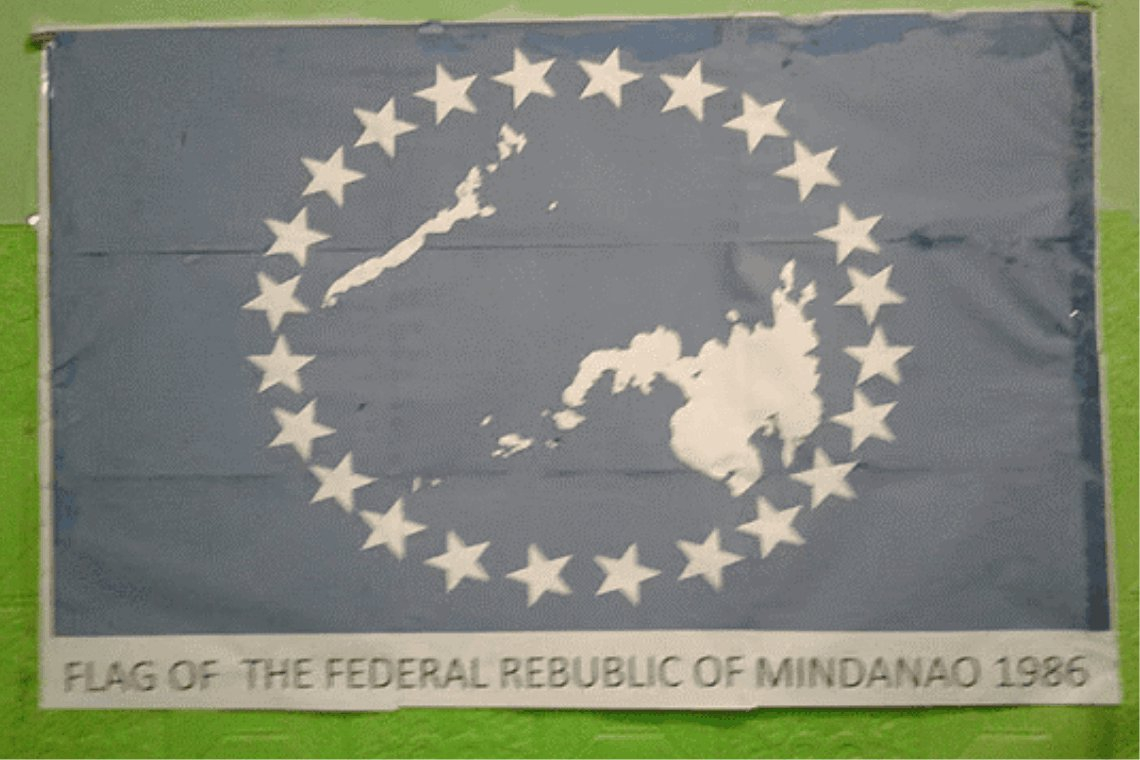
The proposed flag of the Federal Republic of Mindanao, as outlined in a resolution adopted during Mindanao-wide consultations, calls for a peaceful pursuit of independence in line with international law. Source: Perseus Echeminida
The initiative, adopted during meetings in Northern, Central, and Western Mindanao, reflects a growing movement that seeks international recognition rather than armed confrontation.
According to sources familiar with the process, the consultations are among the procedural requirements for the UN to consider the political status of Mindanao under international law. Organizers argue that Mindanao has long been politically and economically marginalized within the Philippine state, a condition they attribute to a centralized governance system based in Manila.
The resolution calls for unity among Mindanaoans and frames independence as a practical and lawful solution to structural inequality. It emphasizes that the movement aims to elevate Mindanao’s status to that of a belligerent entity operating as an independent federal state, consistent with international legal norms. Advocates believe that recognition or endorsement by a single UN member state could open the door to a formal decolonization process, as a UN official based in New York as an unnamed source described, "It will need only one UN member country to endorse or recognize the independence of Mindanao to start the decolonization process."
"It will need only one UN member country to endorse or recognize the independence of Mindanao to start the decolonization process."
The initiative builds on earlier efforts dating back decades, including independence declarations in the 1980s and the Moro National Liberation Front’s political campaigns. Recent consultations included representatives from groups that once pursued armed struggle but now publicly support a peaceful and legal strategy.
A People’s Congress is planned in the coming months to consolidate the resolution and present a unified political position before its formal submission to the UN.
Several groups involved in the consultations have explicitly endorsed what they describe as the Kosovo model. This approach refers to Kosovo’s path toward self rule and eventual independence through international engagement rather than sustained armed conflict.
In Kosovo’s case, the issue of self determination was elevated to international institutions, including the UN, following internal conflict and claims of systemic marginalization. International mediation, recognition by foreign states, and a UN supervised political process ultimately led to Kosovo declaring independence, which was later recognized by a significant number of countries.
For Mindanao advocates, the Kosovo model represents a strategy that prioritizes diplomacy, legal recognition, and a plebiscite allowing the population to decide its political future. It is cited as evidence that independence movements can succeed through international law and peaceful political processes.
Updated headlines for free, straight to your inbox—no noise, just facts.
We collect your email only to send you updates. No third-party access. Ever. Your privacy matters. Read our Privacy Policy for full details.
Parallel to the Mindanao independence movement is a separate but related political initiative led by Sultan Muedzul Lail Tan Kiram of the Sultanate of Sulu. In a widely circulated Facebook post, the Sultan proposed a comprehensive constitutional amendment calling for the formal recognition of the Sultanate of Sulu as a sovereign polity.
"It calls for constitutional recognition of historical territories associated with the Sultanate, substantial fiscal control over natural resources, and the right to maintain security forces loyal to the Sultan."
The proposal asserts that the Sultanate predates the Philippine Republic by several centuries and that its sovereignty was never lawfully extinguished. It calls for constitutional recognition of historical territories associated with the Sultanate, substantial fiscal control over natural resources, and the right to maintain security forces loyal to the Sultan.
The proposed amendment also includes a self-determination clause. It states that failure by the Philippine state to honor these guarantees would justify the peaceful separation of the Sultanate of Sulu and the restoration of full independent sovereignty.
Supporters of the proposal argue in the comments on the Facebook post that constitutional change is a necessary first step and that independence should be viewed as a last resort rather than an immediate objective.
While the Mindanao resolution and the Sulu constitutional proposal arise from different political traditions, both are rooted in claims of historical injustice and the right to self-determination. Each emphasizes peaceful means and legal frameworks, whether through constitutional reform or international recognition.
"While the Mindanao resolution and the Sulu constitutional proposal arise from different political traditions, both are rooted in claims of historical injustice and the right to self-determination."
The Mindanao initiative seeks collective independence or federal restructuring for the entire island, while the Sulu proposal focuses on a specific historical polity with distinct territorial and political claims. This distinction highlights both potential cooperation and potential friction if Mindanao’s political status were to change.
If Mindanao were recognized as an independent or federally restructured entity, questions about the status of historically sovereign territories such as Sulu would become central to any new political arrangement.
Despite growing attention, both the Mindanao independence initiative and the proposed constitutional recognition of the Sultanate of Sulu face significant legal and political obstacles.
Submission of a resolution to the UN does not in itself confer recognition or trigger automatic action. UN processes are deliberative and often shaped by geopolitical considerations, including the positions of existing member states. Any move toward international recognition would likely require sustained diplomatic engagement and support from foreign governments.
“[It] would undermine our solidarity with each other as Filipinos. It would disrupt economic stability and hinder growth opportunities for both Mindanao and the rest of the country.”
Member of the Philippine House of Representatives for the 1-Rider Partylist Rodge Gutierrez said in previous discussions about secession “The constitution is clear: Article I provides for our National Territory; we are one archipelago. There is no constitutional provision or any other legal means that would allow for Mindanao to unilaterally secede.” In his view independence would not only possibly be negative economically for Mindanao, but also “[It] would undermine our solidarity with each other as Filipinos. It would disrupt economic stability and hinder growth opportunities for both Mindanao and the rest of the country.”
Any attempt at independence, whether for Mindanao as a whole or for a specific polity such as Sulu, would either require constitutional amendment or negotiated political arrangements. Both paths involve complex legislative processes and broad political consensus.
There are also differing views within Mindanao and Sulu themselves. While some leaders and organizations support independence or expanded sovereignty, others favor autonomy within the existing state structure or oppose structural change altogether. These internal divisions could shape how any proposal develops in practice.
The initiatives have implications beyond domestic politics and are closely tied to regional and international relations. Proposals that reference historical territories or maritime claims intersect with existing diplomatic agreements and international legal frameworks.
Any discussion involving territories outside current administrative boundaries would be subject to peaceful diplomatic processes and international law. Observers note that such issues cannot be resolved through unilateral declarations and would require engagement with neighboring states and international institutions.
"[B]oth the Mindanao independence movement and the Sulu constitutional proposal are likely to be closely scrutinized not only by the Philippine government but also by regional actors concerned with stability, precedent, and sovereignty norms."
As a result, both the Mindanao independence movement and the Sulu constitutional proposal are likely to be closely scrutinized not only by the Philippine government but also by regional actors concerned with stability, precedent, and sovereignty norms.
For Sulu, both Mindanao independence and constitutional reform carry far-reaching implications. An independent Mindanao could provide space for renegotiating internal sovereignty arrangements and possibly recognizing Sulu as a distinct political entity. Constitutional reform within the existing Philippine state could also grant Sulu greater autonomy, fiscal authority, and formal recognition without immediate separation.
The debate has gained urgency following Sulu’s exclusion from the Bangsamoro Autonomous Region, a development that has raised concerns about political representation, governance, and economic security. In this context, calls for sovereignty, whether through Mindanao-wide independence or Sulu-specific constitutional recognition, reflect deeper uncertainty about the region’s future.
The development also gains added significance in light of former President Rodrigo Duterte’s remarks in 2024, when he openly called for Mindanao’s independence. Against this backdrop, the current ties between VP Duterte and Muedzul take on renewed interest. The most recent public interaction was VP Duterte’s New Year greeting for Muedzul, shared on social media, underscoring a relationship that observers say warrants closer attention given the broader political context.
As the Mindanao resolution moves toward international submission and the Sulu proposal gains public attention, both initiatives signal a renewed phase in long-standing debates over identity, governance, and self-determination in the southern Philippines.
REFERENCES
Business World. (2024, June 2). Analysts: South China Sea tensions threaten Philippine growth prospects. https://www.bworldonline.com/
Daily Tribune. (2025, December 31). Mindanao independence resolution to be submitted to UN. Daily Tribune. https://tribune.net.ph/
Inquirer. (2026, January 6). Palawan legislators oppose inclusion: ‘We’re not part of Mindanao’. Inquirer. https://newsinfo.inquirer.net/
Inquirer. (2024, February 6). More officials oppose Mindanao secession. Inquirer. https://newsinfo.inquirer.net/
Inquirer. (2024, February 11). Mindanao secession ‘won’t stand, contradicts constitution,’ solons say. Inquirer. https://newsinfo.inquirer.net/
Reuters. (2025, October 13). Rift deepens between the Philippines, China over South China Sea. Reuters. https://www.reuters.com/
Rohan, A. (2018, February 2). Kosovo’s path to independence. European Council on Foreign Relations. https://ecfr.eu/article/
Sultan Muedzul-Lail Tan Kiram. (2025, December 30). Proposed Constitutional Amendment. Facebook. https://www.facebook.com/
Sultan Muedzul-Lail Tan Kiram. (2026, January 9). Thank you so much, Her Excellency Madam Vice President Sara Duterte, and Happy New Year to you and your beloved family, too! Facebook. https://www.facebook.com/

KnowSulu is your trusted source for verified facts, news, and legal insights about the Sulu region. Committed to integrity, our mission is to empower the people of Sulu by providing accurate, transparent, and reliable information that matters.