

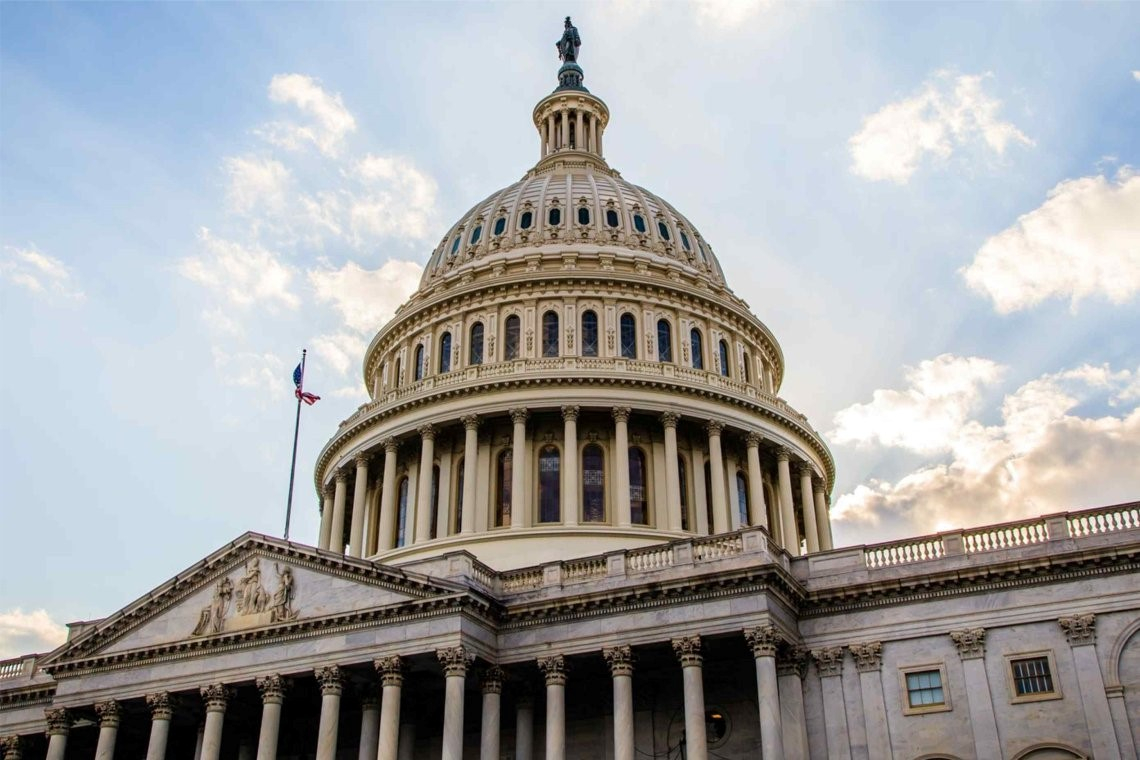
The US has seen an increase in interest for regulating TPLF with arguments citing both the funding of frivolous lawsuits and the threat of undisclosed foreign influence. Image Source: Getty
Earlier legislative efforts—most notably Rep. Darrell Issa’s Litigation Transparency Act (H.R. 1109) and related proposals—focused on broad disclosure requirements for third-party funding in federal civil litigation but failed to gain lasting traction.
By contrast, the latest proposal, Rep. Ben Cline’s Protecting Our Courts from Foreign Manipulation Act (H.R.2675), has advanced through the House Judiciary Committee and reflects a sharper emphasis on national security. In addition to transparency, the bill specifically targets the risk that foreign governments or foreign-controlled entities could use litigation funding to influence U.S. courts, a reframing that appears to have given the issue greater momentum than prior, transparency-only approaches.
One provision would bar sovereign wealth funds from financing lawsuits outright. Another would require litigation funders to disclose foreign investors, ending a practice in which financial backers often remain hidden from courts, opposing parties, and sometimes even claimants themselves.
“One provision would bar sovereign wealth funds from financing lawsuits outright.”
Critics of the proposals have responded with familiar arguments. They warn that stricter rules could undermine access to justice by reducing funding for claimants who cannot afford lengthy litigation. Others argue that such restrictions could make the United States a less attractive destination for global investment.
Supporters of regulation, however, argue that the risks posed by TPLF go well beyond questions of access or capital flows. One long-standing concern is the revival of frivolous lawsuits with speculative or weak claims driven not by legal merit, but by the promise of outsized returns for investors. This dynamic, critics say, increases litigation costs for businesses and distorts judicial priorities, turning courts into arenas for financial arbitrage.
When paired with foreign influence, frivolous lawsuits may be an alien destabilizing force as a consequence of foreign profit interests—or worse yet an intentional ploy to influence or destabilize business and justice. Indeed, when lawsuits become profit-seeking instruments backed by overseas capital, they can take on geopolitical significance. Legal disputes may be prolonged, escalated, or redirected in ways that serve investors rather than the public interest, with destabilizing consequences.
Updated headlines for free, straight to your inbox—no noise, just facts.
We collect your email only to send you updates. No third-party access. Ever. Your privacy matters. Read our Privacy Policy for full details.
This concern is not theoretical. From an ASEAN perspective, the arbitration brought by claimants linked to the historical Sultanate of Sulu illustrates how a violent incident can be repurposed into a destabilizing litigation campaign. The case traces back to the 2013 Lahad Datu incursion—a militant attack in Malaysia’s Sabah region that sharply heightened regional security and sovereignty concerns. The aftermath of the incident was subsequently reframed as the basis for a commercial arbitration claim, possibly only through the financing of the UK-based litigation funder Therium. Although the legal claims have repeatedly failed in court, the funder has resisted allowing the dispute to conclude, less to vindicate a grievance than to preserve the prospect of financial return.
“From an ASEAN perspective, the Sulu arbitration embodies the kind of threat that US law makers are attempted to forestall.”
There are indications, including from comments to the press by the Sulu legal team, that the Therium-backed cause is exploring political avenues to sustain the dispute by involving other countries including China. While such strategies appear impractical and have not gained wide traction, they carry serious implications. At a time of heightened tensions in the South China Sea, reopening a largely settled and sensitive issue between ASEAN neighbors could have significant political costs.
It is this kind of intersection of litigation finance, foreign capital, and geopolitics that American lawmakers and institutions are concerned by, not least in the repeated reports from the US Chamber of Commerce’s Institute for Legal Reform.
The latest proposed restrictions on foreign investment and sovereign wealth funding would have a tangible impact on the American TPLF market, not least with Fortress Investment Group, known for its involvement in the Sulu arbitration following its acquisition of Therium’s caseload in 2025. Fortress is partly owned by Mubadala Investment Company, a subsidiary of Abu Dhabi’s sovereign wealth fund. If the legislation passes, Fortress could be forced either to curtail major portions of its litigation funding activities or to reassess its relationship with foreign sovereign investors.
“Fortress Investment Group, known for its involvement in the Sulu arbitration following its acquisition of Therium’s caseload, will be directly impacted by H.R.2675.”
Fortress’s role in the sector has expanded in recent years. The precise terms of its arrangement with Therium remains unclear, underscoring a broader problem: even as litigation funding becomes more influential, its inner workings are often shielded from scrutiny.
This lack of transparency lies at the heart of the regulatory push. Few jurisdictions require meaningful disclosure of litigation funders, and transnational arbitration forums are especially resistant to oversight. As a result, courts and governments are often left in the dark about who ultimately controls or benefits from major legal actions. The financial interests, strategic motives, and potential political ties behind such cases remain largely invisible.
Why firms like Fortress and Therium pursue these strategies is therefore difficult to assess. Profit is an obvious incentive, but beyond that, little is known. In an environment where disclosure is minimal and enforcement fragmented, the possibility that litigation funding could serve as a conduit for foreign influence cannot be easily dismissed.
The central question raised by the US proposals is a normative one. Should the pursuit of profit, particularly foreign profit, be allowed to interfere with sovereign legal systems, strain international relationships, or shape the outcomes of justice? Whether in American courts or in the delicate political landscape of ASEAN, lawmakers are increasingly asking whether litigation should be a marketplace for global capital, or a public institution insulated from its thirst for profit.
REFERENCES
American Security Project. (n.d.). Perspective – national security implications of foreign third-party litigation financing. American Security Project. https://www.americansecurityproject.org
Cline, B. (n.d.). Investors lament ‘anti-foreign’ litigation funder push. U.S. House of Representatives, Office of Congressman Ben Cline. https://cline.house.gov
U.S. Chamber of Commerce Institute for Legal Reform. (n.d.). Lifting the shadows: Restating the case for reforming third-party litigation funding (TPLF). https://instituteforlegalreform.com
U.S. Congress. (2025). Litigation Transparency Act of 2025, H.R. 1109, 119th Cong. https://www.congress.gov
U.S. Congress. (2025). Protecting Our Courts from Foreign Manipulation Act of 2025, H.R. 2675, 119th Cong. https://www.congress.gov

KnowSulu is your trusted source for verified facts, news, and legal insights about the Sulu region. Committed to integrity, our mission is to empower the people of Sulu by providing accurate, transparent, and reliable information that matters.