

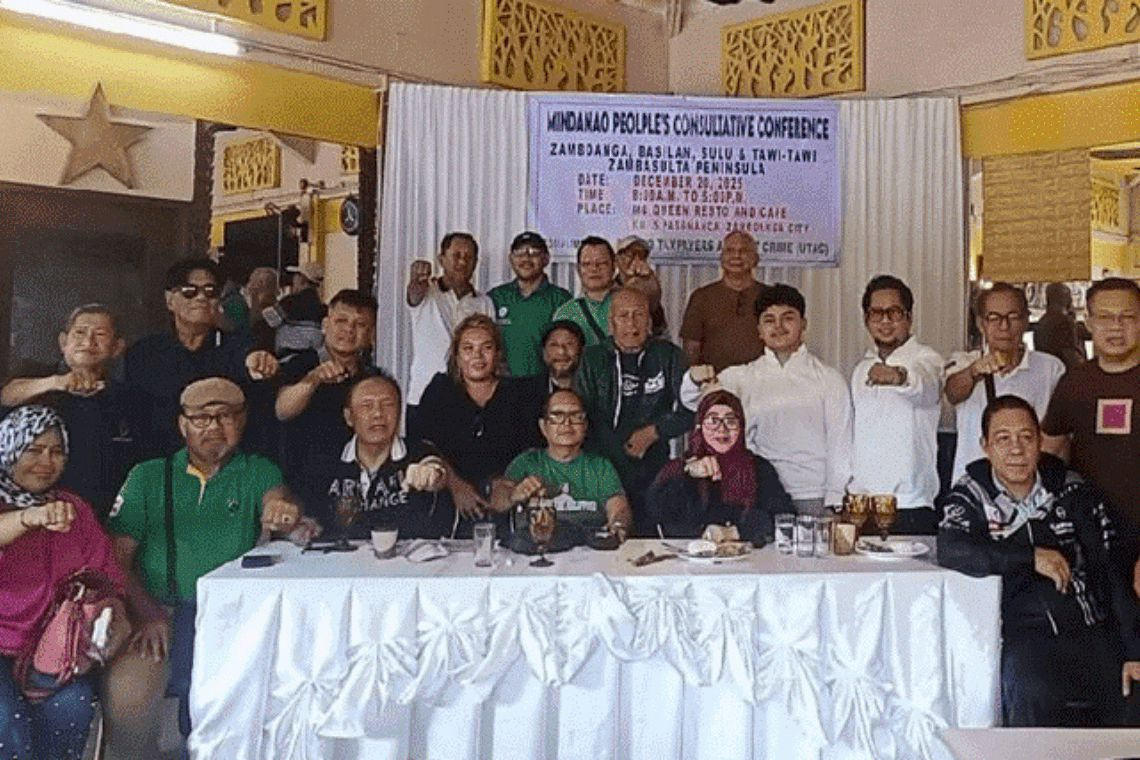
Participants at the at the Mindanao People's Consultative Conference in Zamboanga City on December 20, 2025, with further meetings to follow with the goal to unveil a manifesto and a set of resolutions for the future of the area in early February 2026. Source: TikTok - ccgtcghub
The meeting held on December 20, 2025, which brought together mayors and leaders from across the region, underscored a growing sentiment among Mindanaoans: that their region has been politically isolated and neglected in the national dialogue. This meeting, under the leadership of the Mayor’s Sara Duterte Alliance (MASADA), was seen as a platform for discussing the pressing issues facing the region, which have led some to propose a revival of Mindanao's push for independence.
Mindanao has long struggled with issues of autonomy and self-determination, with deep-rooted political, cultural, and economic challenges. The region has experienced decades of armed conflict, stemming from the historical injustices faced by the Bangsamoro people and the failure of successive Philippine governments to address their grievances. Cesar Cuntapay, governor of the MASADA said about the recent meeting that “This is about making sure Mindanao is heard.”
“This is about making sure Mindanao is heard.”
The conflict in Mindanao is rooted in the lack of meaningful governance, with the central government often failing to deliver social progress or resolve deep-seated issues. The people of Mindanao, have repeatedly called for a political system that reflects their cultural identity and governance needs.
At the recent consultative meeting, it became clear that frustration with the central government’s treatment of Mindanao is growing. Cuntapay said "Mindanaoans will come up with a united stand on the current state of the country, which has practically isolated Mindanao in the political development of the nation." This sentiment echoes a movement from 1986 when the late lawyer Reuben Canoy spearheaded the Declaration of Mindanao Independence.
"Mindanaoans will come up with a united stand on the current state of the country, which has practically isolated Mindanao in the political development of the nation."
Updated headlines for free, straight to your inbox—no noise, just facts.
We collect your email only to send you updates. No third-party access. Ever. Your privacy matters. Read our Privacy Policy for full details.
The 1986 declaration was signed by 500 delegates from Mindanao, Sulu, and Palawan, and submitted to the United Nations. Despite the lack of international recognition, the movement proposed that Mindanao be recognized as an independent entity, separate from the Philippines. While the original declaration did not succeed, it remains a symbol of Mindanao’s enduring desire for self-governance. During the consultative meeting, there were suggestions that such a movement could be revived, potentially with international support from countries like China or Russia, which could elevate Mindanao’s status and make its independence a more realistic goal. A source claimed to the Daily Tribune "Once a country such as China or Russia recognizes Mindanao, the UN would have no choice but to acknowledge its belligerency status."
The recent loss of the supposed heirs of the Sultanate of Sulu case in Paris has added a layer of complexity to the region’s political discourse. The case, which sought compensation from the Malaysian government over a disputed lease agreement on Sabah, was a significant legal battle for the supposed heirs. However, their defeat has raised doubts about the legitimacy of their claims and, by extension, the broader political ambitions tied to the Sulu Sultanate.
Many have raised concerns about the motivations behind the Sulu heirs' actions, particularly since their case lacked a strong legal foundation. Instead of addressing the region's pressing socio-political and economic challenges, the case diverted attention to a controversial claim that ultimately failed.
"Many have raised concerns about the motivations behind the Sulu heirs' actions, particularly since their case lacked a strong legal foundation."
The defeat of the Sulu heirs' case also serves as a stark reminder of the foreign influence in the region, which has often been driven more by financial interests. Critics argue that the focus on this dispute, rather than on addressing poverty and violence, has only distracted from the real struggle of the people in Sulu, and the whole Mindanao region, undermining the credibility of any broader movements that seek to address the region’s urgent concerns.
The future of Mindanao remains uncertain. Although the peace process has made strides, groups like the MNLF and MILF still retain significant military power. This summer headlines were filled with the suspension of the decommissioning of the remaining 14,000 MILF fighters under the 2014 peace deal. The MILF expressed frustrations over the slow progress of socio-economic benefits that were promised by the Philippine Government. Decommissioning of fighters is linked with the government fulfilling their promises. During the 37th GPH-MILF peace panels meeting held in Davao City on December 19, 2025, promises were made that the peace process and disarming continues.
"During the 37th GPH-MILF peace panels meeting held in Davao City on December 19, 2025, promises were made that the peace process and disarming continues."
In international media the question whether southern Philippines are a "terrorism hotspot" has flared up again since the Bondi beach attack, with newspapers bringing back memories of how "the southern Mindanao region, roiled for decades by Islamist separatists, communist rebels and warlords, has long been fertile ground for jihadist groups, from those affiliated with al-Qaida, Jemaah Islamiyah and most recently Islamic State (IS)." Although coverage mostly ends with how terrorist groups have been weakened in recent years, the aftertaste stays.
Online, the slow process in the region raises questions about the future of the region. The presence of foreign interests, particularly from China and Russia, may further complicate the situation. There is speculation that these foreign powers could be preparing for a scenario in which Mindanao declares independence, providing military support and recognition for a new “Republic of Mindanao.” In such a scenario, the creation of a separate Mindanao republic could become more plausible, with groups like the MNLF and MILF being legitimized as the official armed forces of the new state. However, whether this would lead to peace or further conflict remains to be seen.
The region’s economic stagnation, compounded by the social costs of war, has discouraged foreign investments. The impact of the ongoing tensions in Mindanao has been catastrophic. Millions of civilians have been displaced, and many have lost their lives due to violence that spares neither age nor gender. The toll on Mindanao's people has been profound, with entire communities caught in the crossfire of competing armed groups.
As the people of Mindanao continue to grapple with their identity and aspirations for self-governance, the region’s future hangs in the balance. The calls for independence, while gaining traction, are complicated by internal divisions, external pressures, and the shadow of historical claims like that of the Sulu heirs. The struggle for self-determination will continue to shape the region’s political landscape for years to come.
Unity is not only cultural; it is strategic. Mindanao’s communities, Moro, Lumad, and settler populations alike, must reject attempts to pit one group against another, whether through misinformation, patronage politics, or outside sponsorship. The region’s future should not be negotiated in the language of foreign interests or external rivalries. Any assistance from abroad must support locally defined priorities, strengthen institutions, and respect the right of Mindanao’s people to decide their own political and economic direction without interference designed to divide and control.
The Mindanao talks will continue with the goal to unveil a manifesto and a set of resolutions for the future of the area in early February 2026. These discussions should reaffirm a clear principle: lasting peace and prosperity will come from cooperation among Mindanao’s own stakeholders, guided by unity, transparency, and a common commitment to protect the dignity and future of the region’s people.
The peace process and development can be solved when all parties work together, and not by the threat of outside actors like China getting involved. The Sulu heirs case has shown that the hope for support dies quickly, when the realization hits that it was never about progress and prosperity of the region, but always about financial gain and political power.
REFERENCES
Daily Tribune. (2025, December 18). Mindanao mayors set state of the nation consultative meet in Zamboanga. Daily Tribune. https://tribune.net.ph/
Daily Tribune. (2025, December 21). Mindanao-wide state of the nation consultative meeting snowballs. https://tribune.net.ph/
Luwaran. (2025, December 19). 37th GPH–MILF Peace Implementing Panel Meeting. https://dhznbxi9ccb8w.cloudfront.net/
PH Defense Community. (2025, August 19). The Moro Islamic Liberation Front MILF suspends the decommissioning of its 26,000 strong MILF Fighters. Facebook post. https://www.facebook.com/
PSA Intelligence. (2025, August 8). Moro Islamic Liberation Front Suspends Decommissioning of Remaining Fighters. https://psaintelligence.com/
Reddit. (2025, December 5). The Philippines is in trouble, and honestly, we deserve it. Reddit. https://www.reddit.com/
The Guardian. (2025, December 17). Islamic extremism in the Philippines: is it a terrorism hotspot, and which groups are active there? https://www.theguardian.com/

KnowSulu is your trusted source for verified facts, news, and legal insights about the Sulu region. Committed to integrity, our mission is to empower the people of Sulu by providing accurate, transparent, and reliable information that matters.