

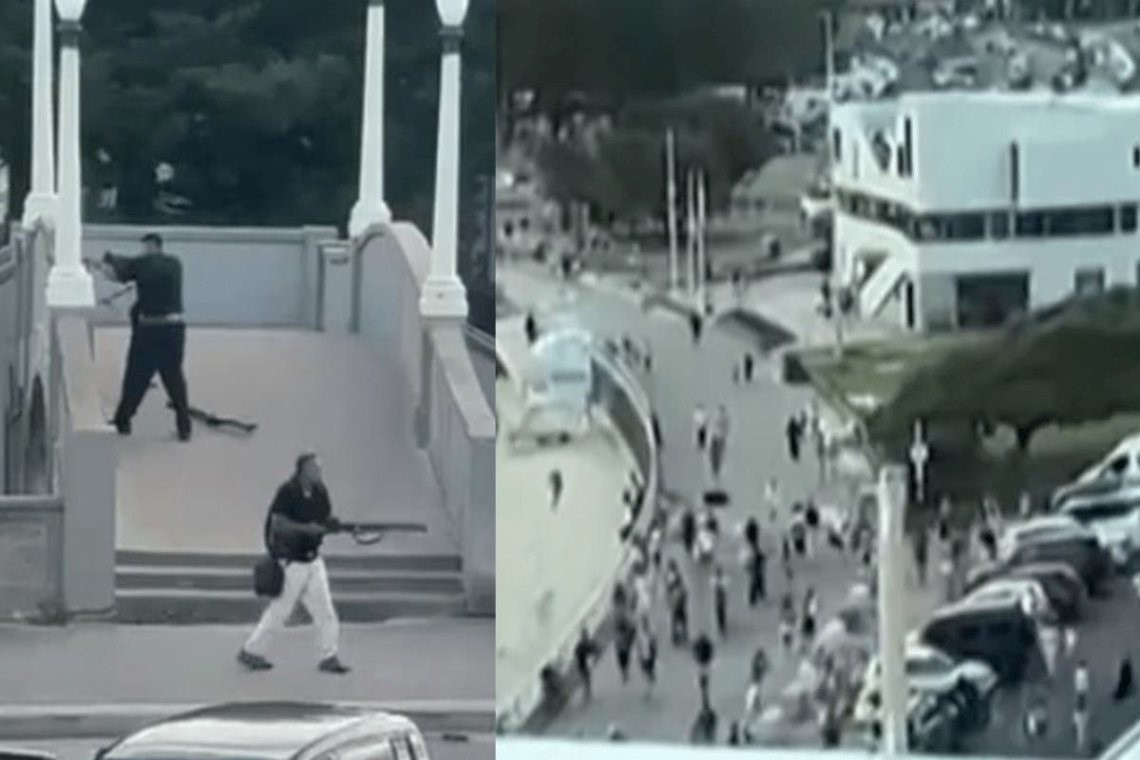
Bondi Beach attack, which authorities investigated and treated as an act of terrorism and that resurface sulu well known names. Image Source: financialexpress.com
Bondi Beach didn’t look like a battlefield until it was. A father and son walked into a Hanukkah celebration on Sydney’s shoreline and opened fire. By the time the shooting stopped, fifteen people were dead. In the hours after, the case hardened into a terrorism investigation, and the story shifted from the beach to the backstory—who these men were, what pushed them, and what they did in the weeks before the attack.
Sources then introduced the detail that instantly changed the geography of the narrative: the alleged perpetrators, Naveed Akram (24) and his father Sajid Akram, had travelled to the Philippines in November and then moved on to the country’s south for what a senior counterterrorism official described as “military-style training.” They returned to Australia in late November—weeks before Bondi.
That single allegation does what these allegations always do. It widens the circle. It adds a second country to the investigation. It drags old regional fears back into the present tense. And it forces everyone to stare at the same question from different angles: if there was training, where exactly did it happen—and with whom?
Updated headlines for free, straight to your inbox—no noise, just facts.
We collect your email only to send you updates. No third-party access. Ever. Your privacy matters. Read our Privacy Policy for full details.
On the Philippine side, immigration information cited by sources places the two men arriving in Manila on November 1 and continuing to Davao, then leaving on November 28 back to Sydney. That’s the clean part of the story: dates, flights, entry and exit.
The messy part is everything in between. Even sources describing the alleged training concede that the pair’s exact movements and locations in the southern Philippines have not been publicly confirmed. For now, the accusation sits in that uncomfortable space where it’s too serious to ignore and too incomplete to treat as settled.
For most readers, “southern Philippines” will register as a security headline. For anyone who follows the Sulu dispute, it also triggers a different, older memory—almost reflexively.
Because this is the same country tied to a name Malaysia put on its terrorist list in 2023: Muhammad Fuad Abdullah Kiram, also listed as “Fuad A. Kiram.” Not the same story, not the same people, and no public evidence connecting Bondi to Fuad or the Sulu claim. Just a coincidence of geography, and the way geography can resurrect names.
Bondi pulled attention back to Mindanao. Mindanao pulled attention back to the wider ecosystem of narratives that circulate whenever “terrorist training” and “southern Philippines” appear in the same sentence. And in that ecosystem, Fuad’s designation is one of the most politically charged facts Malaysia has placed on the record.
In isolation, a terrorist designation from 2023 sits in an archive: important, but static. A mass killing in 2025 is different: it’s an event that forces the public to revisit old files and re-open familiar arguments.
Once sources alleged the Bondi perpetrators sought training in the southern Philippines, it became almost inevitable that people would remember: Malaysia didn’t just talk about the Sulu network as a threat; it formally named a prominent Sulu claimant as a terrorist. That remembered detail doesn’t explain Bondi. It doesn’t prove anything about the Philippines trip. But it does explain why, in the middle of a tragedy on an Australian beach, an old name from the Sulu story suddenly started circulating again.
If the Philippines allegation is real, it will eventually have to become specific: places, intermediaries, and evidence that can survive daylight. If it stays vague, it will remain what it is now—an accusation powerful enough to travel, but not yet clear enough to close the loop.
Either way, Bondi has already done one thing beyond the horror of the attack itself: it has revived attention on a Southeast Asian arc of “terror” allegations that keeps looping back to the same terrain—and, sometimes, the same names.
REFERENCES
Source on the Bondi Beach attack, the “military-style training” allegation, and the November travel timeline - ABC: https://www.abc.net.au/
Source on Philippine immigration confirmation of entry (Nov 1), onward travel to Davao, and exit (Nov 28) - Reuters: https://www.reuters.com/
Source (KnowSulu) revisiting Fuad Kiram’s designation and Malaysia’s stated framing: https://knowsulu.ph/
Source (Malaysia MOHA list) showing the entry for “Muhammad Fuad Abdullah Kiram” / “Fuad A. Kiram” with listed date “6 April 2023”: https://www.moha.gov.my/

KnowSulu is your trusted source for verified facts, news, and legal insights about the Sulu region. Committed to integrity, our mission is to empower the people of Sulu by providing accurate, transparent, and reliable information that matters.